Mini-project. A file-based personal knowledge vault, read and written directly by Claude, built to carry context between otherwise isolated AI conversations.
Status: in service. Built 25-26 August 2026, iterated across three revisions.
At a glance
| Objective | A single Claude-readable knowledge store that survives the end of any conversation, replacing six isolated Claude Projects |
| Scope | Folder architecture across 6 Claude Projects, migration of 11 conversation distillations, bulk ingestion of 157 files (~71 MB) |
| Duration | Built 25-26 August 2026, iterated across three revisions |
| Method | Single operator, folder-based markdown vault, verified cold - no memory of the build conversation |
| Findings | 3 failure modes identified and corrected, 28 duplicate file groups resolved, 6 verification checks defined |
| Status | In service |
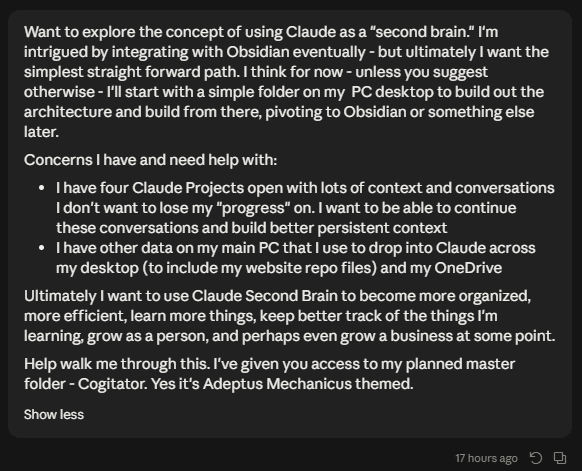
I have been using Claude across six separate Projects for months, and every one of them was its own island. The finance work did not know about the certifications, the certifications did not know about the homelab, and none of it knew about the resume that was supposed to be built out of all three. This is the writeup of what I did about that, and what it cost.
The narrative version, with the reasoning and the jokes, is in the companion article. This page is the technical record.
Problem
Conversational AI retains context within a single conversation and discards it at the conversation boundary. Project-level knowledge bases persist, but they are static uploads that must be maintained by hand. The practical result is threefold:
- Work performed in one conversation is unavailable to the next, including within the same Project.
- Material relevant to more than one Project must be duplicated into each, after which the copies diverge.
- Source material was distributed across OneDrive, a local disk, and several Project knowledge bases with no canonical location.
The requirement was a single authoritative store, readable by Claude without manual upload, that survives the end of any given conversation.
Architecture
A plain markdown folder tree was selected over a dedicated application - Obsidian was
evaluated and deferred. The reasoning: a folder of .md files carries no proprietary
format, is greppable, and can be adopted by Obsidian later with no migration step,
because Obsidian opens a folder rather than importing one.
The vault is located inside OneDrive, which supplies off-machine backup and 30 days of per-file version history at no additional configuration cost. An independent offline copy is retained separately.
Top-level structure:
| Item | Function |
|---|---|
0. About Evan.md |
Master context brief. The only file uploaded to Project knowledge. |
0. START HERE.md |
Operating manual - conventions, structure, standing rules. |
00. Inbox/ |
Unstructured capture. The single staging area. |
1. - 6. |
One folder per Claude Project, numbered to match. |
7. Resources/ |
Cross-project material - writing reference, prompts, field lessons. |
8. Logs/ |
Learning log and weekly reviews. |
9. Archive/ |
Superseded material, retained. |
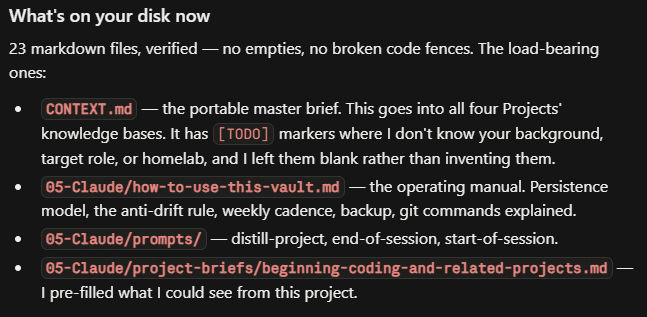
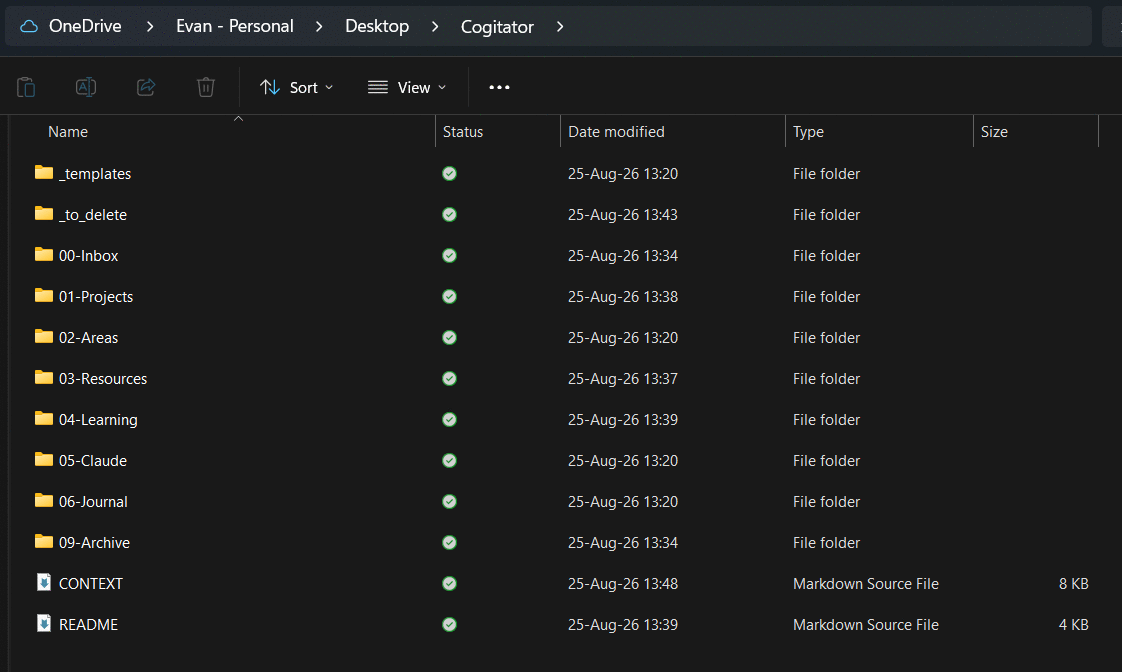 First generated layout - rejected. Technically sound, but not how the operator’s own OneDrive is organized.
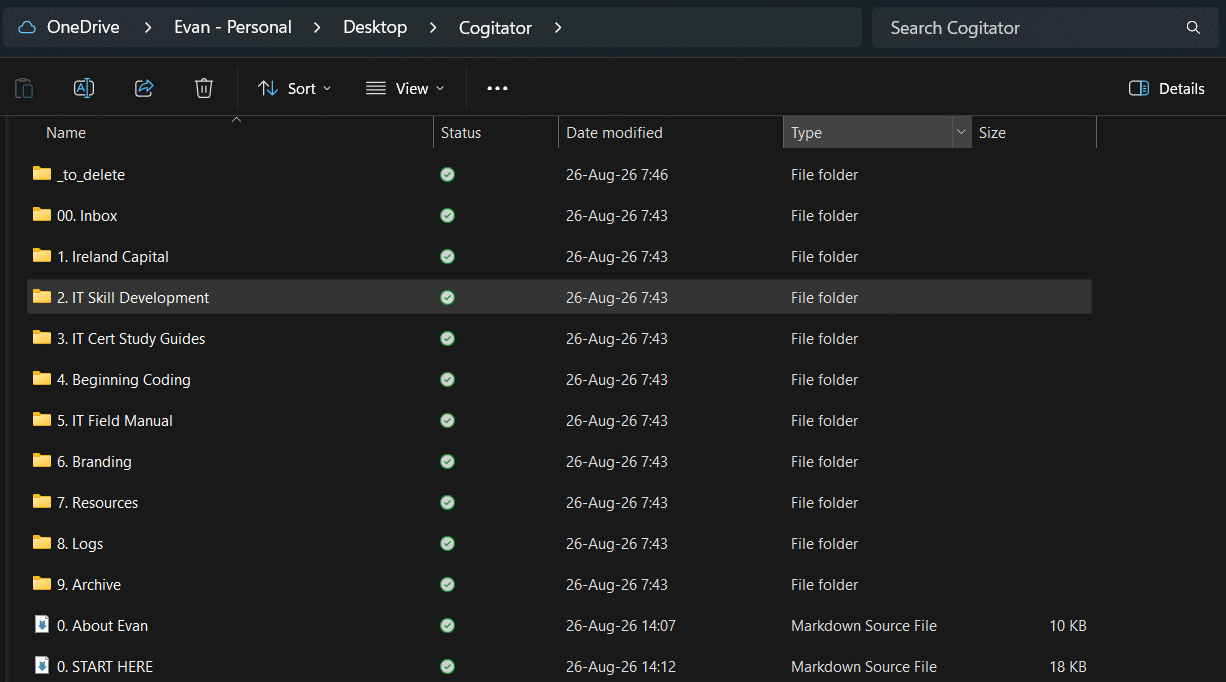 Current layout, derived from existing OneDrive conventions
Each of the six project folders is structurally identical: 0. Brief.md,
1. Working/, 2. Reference/, 9. Archive/. Uniformity was chosen over per-project
optimization so that any folder can be navigated without inspection, by the operator or
by an agent.
Naming conventions were derived from the existing OneDrive hierarchy rather than
imposed: numbered N. Title Case folders, zero-padding to pin items above 1.
(0. sorts before 00. before 000.), ao DDMMMYY for as-of dates, _vN for
explicit versions, and <Target> - Submission for per-recipient output sets. Prior
versions are retained indefinitely and never deleted.
Component Function
0. About Evan.md carries identity, background, working preferences, current
focus, and an explicit statement of skill level. It is the sole file uploaded into each
Project’s knowledge base, on the reasoning that it changes on a monthly cadence and a
second copy therefore remains accurate between edits.
0. START HERE.md carries the conventions above, the inter-project flow, filing
rules, and a “settled” table enumerating decisions that are closed. The table exists
because two separate cold sessions independently rediscovered and reported the same
resolved contradiction, consuming context before any task was issued.
N. <Project>/0. Brief.md carries per-project state under seven fixed headings:
purpose, current state, key decisions and rationale, dead ends, conventions, open
threads, and working preferences specific to that project. Briefs are read live from
disk and are not uploaded to Project knowledge - they change per session, and a
stale uploaded copy would be authoritative to an agent that has no basis to doubt it.
Inter-project flow. The six projects are not independent. Material moves along fixed edges:
| From | To | Content |
|---|---|---|
| Cert Study Guides | IT Field Manual | Corrected study material, exam framing removed |
| IT Skill Development | IT Field Manual | Lab findings as integration modules |
| IT Skill Development | Beginning Coding | Portfolio case studies for publication |
| Beginning Coding | IT Field Manual | Scripting and programming knowledge |
| IT Field Manual | Beginning Coding | Published manual versions |
| Branding | Beginning Coding | Positioning and site copy |
A completed lab produces two distinct deliverables rather than one: a narrative case study for the site and a separate merge module for the manual. The two serve different readers and are structurally different documents.
Migration
Existing conversational context was extracted using a standardized distillation prompt, run at the end of each source conversation rather than in a new one. A new conversation cannot read prior conversations within the same Project; extraction must therefore occur while the source context is still resident.
Eleven distillations were produced across six Projects. These were merged into six briefs programmatically rather than by hand, on the reasoning that a hand-merge of approximately 150 KB introduces transcription error into precisely the details that make the material useful. The merge was verified by asserting that every non-heading, non-blank line from each source appears verbatim in its destination: 880 lines checked, zero missing.
Three cross-file conflicts were identified during the merge and would have been silently absorbed by a naive concatenation:
- Chronological inversion. Two briefs for the same project carried “as of” dates reflecting when each was distilled, not the state each described. The apparently older document described the later reality. Absorbed uncritically, this would have directed future sessions to restart a completed migration.
- Contradictory skill assessment. One brief described the operator as an experienced MSP technician; every other source described a career-changer with no professional experience. The assessment governs the level of explanation in every subsequent response.
- Stale cross-project thread. One project recorded a handoff as not started; the receiving project recorded it as completed and integrated.
Bulk ingestion followed: 157 files, approximately 71 MB, comprising screenshots,
playbooks, study guides, four manual versions, and resume drafts. Files were sorted by
project and by lifecycle stage - active work to 1. Working/, completed material to
2. Reference/.
Deduplication was performed by MD5 checksum. Twenty-eight exact-duplicate groups were identified, totaling approximately 9 MB: one duplicated study guide, two redundant archive files, one file identical to its own renamed copy, and 26 screenshots existing twice under both raw and published filenames. One copy of each was retained. The published rename was preserved as a mapping table with a regeneration script rather than as a second set of files.
No file was deleted. Superseded material was relocated to a staging folder for operator review, on the principle that an agent operating on a personal archive should not hold delete authority.
Failure Modes & Corrections
Three defects were introduced during construction. All three originated in instruction files rather than in structure, and all three were only detectable by running the system cold.
Symptom: A fresh session reported that a referenced context file did not exist. Diagnosis: The master context file had been renamed twice during reorganization. The saved start-of-session prompt still referenced the original filename. Resolution: All instruction files were audited for stale references and corrected. The lesson generalizes: instructions that name files decay silently the moment files are renamed, and the author is the least likely person to notice.
Symptom: A session uploaded three files into a Project knowledge base without being asked, creating duplicate copies of material designated as disk-canonical. Diagnosis: Every brief carried a header instruction reading “upload this file to that Project’s knowledge base.” The instruction was authored as a note to the operator. An agent with file access read it as a directive addressed to itself and complied correctly. Resolution: The instruction was inverted to an explicit prohibition, and a standing rule was added forbidding uploads on agent initiative. Operator notes stored in files an agent reads are not notes. They are instructions, and they will be executed.
Symptom: A session declined to proceed with a requested task, citing the operator’s own stated priorities. Diagnosis: The current-focus section of the context file concluded with the line “Everything else waits.” Written as a personal scheduling note, it is read by an agent as an enforceable constraint. Resolution: Priority statements were reframed as context rather than as gates, with an explicit rule permitting a one-line advisory and requiring the work to proceed regardless. I would flag this as the least obvious of the three and the most likely to recur: a reference document that describes intent can be read as a document that governs behavior, and the distinction has to be stated rather than assumed.
Verification
The following checks are run against the vault after any structural change:
| Check | Method | Expected result |
|---|---|---|
| Merge completeness | Every source line matched against destination | 880 of 880 lines present |
| Reference integrity | Every file path cited in instruction files resolved | 0 broken |
| Markdown validity | Code fence parity per file | All even |
| Flow consistency | Every declared outbound edge matched against the corresponding inbound declaration | 6 of 6 matched, 0 orphans |
| Duplicate detection | MD5 across the ingestion set | 28 groups identified and resolved |
| Convention compliance | Prohibited punctuation absent from authored files | 0 occurrences |
The flow consistency check is the one worth noting. Each project’s brief declares its own inbound and outbound edges independently. A declared outbound edge with no corresponding inbound declaration indicates a documented handoff that the receiving project does not know about, which is the failure mode that produced conflict 3 above.
Limitations
- The system depends on an unautomated habit. Context is written back at the end of a session by explicit instruction. There is no mechanism that enforces this, and the vault degrades silently if it is skipped.
- Two access surfaces behave differently. A standard conversation reads Project knowledge only. A Cowork session with the folder connected reads both. The distinction is invisible to the operator until a session produces an answer based on incomplete context.
- Agents cannot delete on this device, by design. Superseded material accumulates in a staging folder until removed manually.
- One project’s material is sensitive and is excluded from any future version control that is not private.
- Distilled sections are dated snapshots and are explicitly marked as historical. They are retained unedited, which means each brief contains material that is known to be superseded by the sections above it.
Six days in, the thing I did not expect is how much of the value came from the audit rather than the build. Constructing the folders took an afternoon. Finding out that my own notes described my skill level two different ways, that a handoff was recorded as incomplete in one place and finished in another, and that I had written a scheduling note that a machine would read as a rule - that took running the whole thing cold and watching where it snagged.
Which is roughly the argument for building one of these at all. The system is not smarter than I am. It just does not forget what I told it last week, and it has no particular investment in my being right.
Screenshots
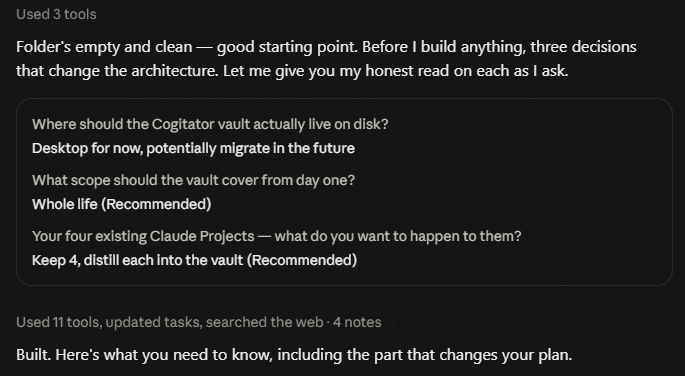
A handful of frames from the build - the prompt, the first rejected layout, and the conversation that produced the layout actually in use.